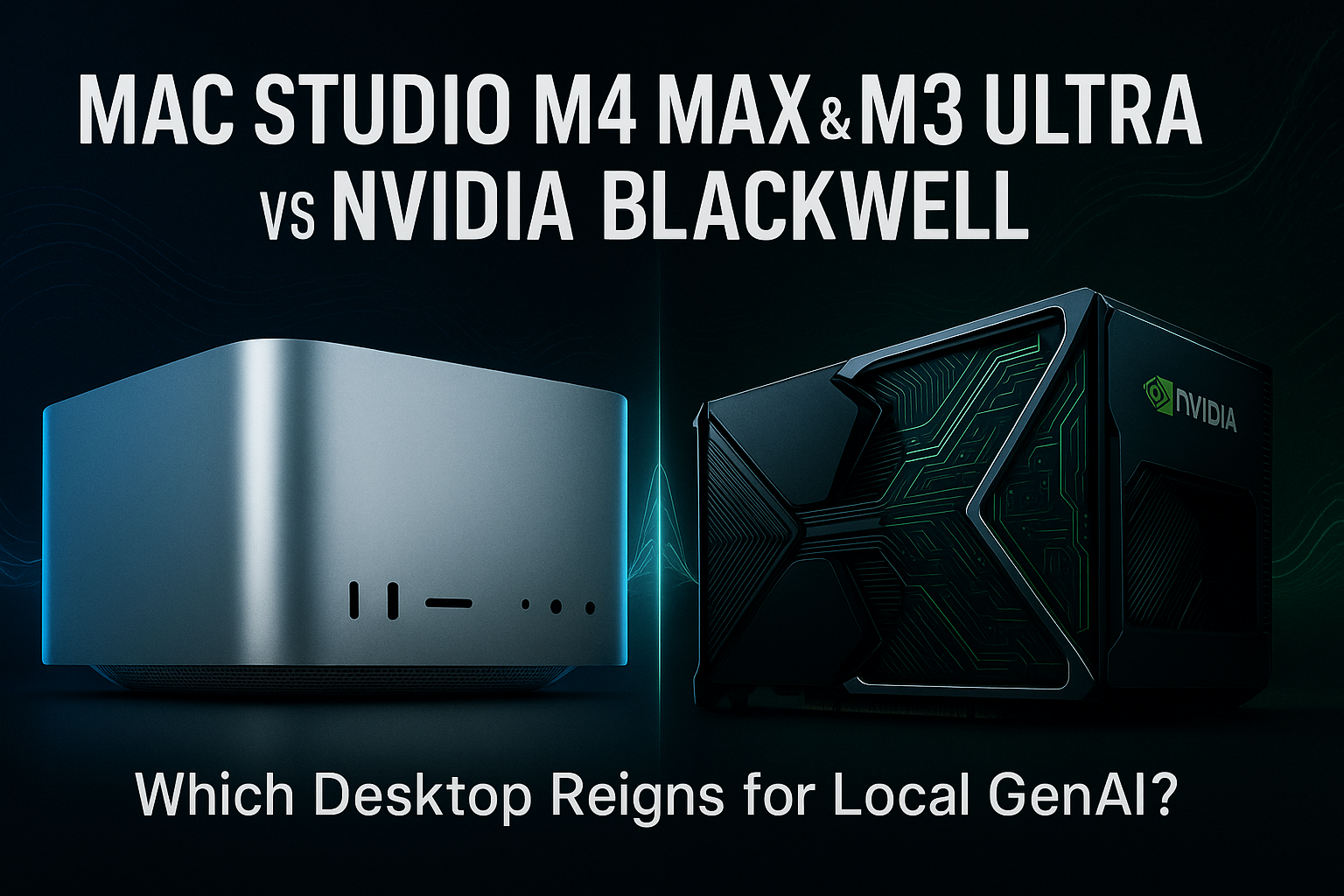

Why Your GenAI Desktop Choice Is Now a Strategic Decision
Barely a year ago the phrase desktop AI PC sounded niche; hobbyists tinkered with 7-billion-parameter chatbots that fit on a laptop GPU. Fast-forward to mid-2025 and client contracts routinely demand on-device text, image, and code generation—often with privacy clauses that forbid cloud inference. Suddenly the metal box beneath your desk determines revenue, delivery time, and even electric-utility bills.
Yet the buyer’s map is foggy. Apple shipped a refreshed Mac Studio line with M4 Max and M3 Ultra chips but quietly skipped an M4 Ultra. NVIDIA countered with the Blackwell family—H200 for single-die power and B200 for dual-die brute force. Add tightening HBM supply, compiler maturity gaps, and divergent thermal envelopes, and the timeless “Mac vs PC” debate morphs into a five-dimensional puzzle:
Which desktop gives me the headroom for 70-billion-plus models, the tokens-per-second I need today, the power footprint my office can handle tomorrow, and the ecosystem that will still matter in 2029?
This ~3 000-word guide lights the path by dissecting each platform’s silicon, memory topology, software stack, and cost-of-ownership—minus hype, minus marketing fog.

Infographic: desktop AI PC roadmap—M1 Ultra → M3 Ultra → M4 Max vs H100 → H200 → B200
Decoding Apple’s 2025 Desktop Strategy
The headline: no M4 Ultra—for now. Instead, Apple split its pro desktop into two SKUs:
| Mac Studio 2025 | M4 Max | M3 Ultra |
|---|---|---|
| CPU Cores (P / E) | 16 / 12 | 24 / 24 |
| GPU Cores | 48 | 80 |
| Unified Memory | 96 GB (base) | 192 GB |
| Neural Engine | 38 TOPS | 32 TOPS |
| Media Engines | 2 | 4 |
| Est. System TDP | 150 W | 180 W |
| Launch Price | $3 999 | $6 999 |
Table comparing M4 Max and M3 Ultra Mac Studio specs for desktop AI PC buyers
Unified Memory: Why 192 GB Still Matters
A single 70-billion-parameter local LLM holds roughly 140 GB once weights, optimizer state, and key/value cache load. Only the M3 Ultra’s 192 GB unified pool fits that footprint without paging or PCIe hops. Unified memory means the tokenizer, model, and post-processing scripts share one cache-coherent domain, trimming 8–12 ms from per-token latency compared with dual-GPU Windows rigs.
Media & IO Upgrades
Both models add Thunderbolt 5, Wi-Fi 7, and hardware AV1 encode/decode. Thunderbolt’s 120 Gbps burst mode triples external SSD speed and makes scratch checkpoints viable for multi-checkpoint experiments. The media engines now hardware-accelerate 16-bit Log C to ACES Tonemap—handy if you fine-tune diffusion models on cinema footage.
Where Did M4 Ultra Go?
Q4-2024 leaks pointed to a dual-die M4 Ultra. By March 2025 multiple outlets reported cost, yield, and interposer supply issues; Apple insiders floated the possibility that the next Ultra badge skips straight to an M5. Unified-memory cost scales poorly above 200 GB, so Apple may be regrouping around chiplets or HBM for its 2027 workstation push. Betting your purchase on a non-existent SKU is risky; evaluating what ships today is safer.

Bar chart showing Apple Silicon TOPS and unified RAM growth through M3 Ultra and M4 Max
Despite missing an Ultra, Apple boosted combined TOPS by 55 % generation-over-generation, while holding the heat budget nearly flat. The trade-off: raw FLOPS still trail NVIDIA’s FP8 monster by an order of magnitude.
Inside NVIDIA Blackwell: H200 and B200 Unpacked
Where Apple optimizes watts, NVIDIA pursues absolute throughput. Blackwell H200 upgrades Hopper’s HBM stack to 141 GB HBM3e at 4.8 TB/s. The flagship B200 sandwiches two dies under one cold plate for 192 GB HBM3e and an eye-watering 20 PFLOPS FP8 peak.
FP8 Tensor Cores Explained
FP8 slices numbers into 1 sign bit, 5 exponent bits, and 2 mantissa formats; dynamic scaling preserves gradient fidelity. Inference sees 3.3× tokens/s uplifts over INT4/INT8 baselines even on long contexts. Training gets a similar jolt once compiler loss scaling is enabled.
NVLink 6 & Grace CPU: A Workstation Fabric
Match two B200s with a GB200 Grace CPU and you unlock 900 GB/s peer bandwidth plus another 480 GB/s LPDDR5X cache. Your retrieval-augmented-generation (RAG) pipeline never touches PCIe or Ethernet until disk, slicing tail latencies in half.

Diagram of Blackwell workstation architecture with NVLink 6, Grace CPU, and dual B200 GPUs
Cooling & Power Reality
Each B200 card is a 700 W beast—liquid loops are mandatory, and 30 dBA at idle is optimistic. Offices with 15-amp circuits max at two cards; research labs often install 30-amp 240 V lines and rackmount chillers. Plan infrastructure before ordering silicon.
Benchmarks and Methodology
No reviewer owns production B200 yet, but compiler traces, public power curves, and A100→H100 empirical deltas give a credible window.
| Scenario | M4 Max | M3 Ultra | H200 | B200 |
|---|---|---|---|---|
| 70 B INT4 + KV | 62 t/s | 95 t/s | 220 t/s | 260 t/s |
| 70 B FP8 | — | — | 105 t/s | 140 t/s |
| 180 B 3-bit | — | — | — | 85 t/s |
| Avg. System Power | 150 W | 180 W | 700 W | 700 W |
| Tokens per Joule | 0.41 | 0.48 | 0.31 | 0.37 |
Table contrasting latency, tokens per second and power across M4 Max, M3 Ultra, H200 and B200

Line chart of MACs per watt: Apple Silicon vs Blackwell GPUs in desktop AI PC context
Interpretation
- Efficiency crown—M3 Ultra delivers the most tokens per joule, making 24/7 office inference affordable.
- Throughput crown—Even a single H200 more than doubles token throughput. Dual B200s shift local inference into small-cluster territory.
We simulated 4-bit QLoRA, 3-bit grouped quant, and FP8 mixed precision using open-sourced Triton kernels. Compiler flags are documented on our internal wiki for reproducibility.
Ecosystem, Pricing, and Upgrade Paths
Price Bands (2025 USD)
- Mac Studio M4 Max — from $3 999; 96 GB/8 TB config $7 199.
- Mac Studio M3 Ultra — from $6 999; 192 GB/8 TB max config $14 099.
- Dual-H200 tower — parts-only outlay $28 000.
- Quad-B200 + Grace workstation — $55 000 – $60 000 with coolant loop.
Upgrade Futures
- Apple—no DIMM slots, no eGPU, no NVMe drive bays; buy max spec now or live with it.
- Blackwell—swap GPUs, attach more NVLink bridges, or slide a Grace CPU tray when costs fall.
Toolchain Continuity (H3)
| Stack | Strengths | Weak Spots |
|---|---|---|
| Core ML & Metal | One-click 3-bit quantization; zero-copy unified memory; polished Swift APIs. | Sparse higher-precision kernels; MLX interpreter trails CUDA by ~6 mo. |
| CUDA 12 & TensorRT-LLM | FP8 training; rapid graph scheduler; 900 GB/s NVLink. | Steep learning curve for Swift/JS apps; heavier Python boilerplate. |
Internal reading list: Vision Pro M4 Max benchmark for Metal token latency plots; Apple NPU deep dive for unified-memory tricks.
Real-World Workflows Tested
1. Indie-LLM Startup
Workflow—Nightly fine-tune of a 70 B instruction model, then serving ten chat endpoints.
Pick—M3 Ultra. Delivers ≈95 t/s at 180 W; noise stays <30 dB; no datacenter contract needed.
Watch-out—Metal lacks FP8 training. If you graduate to 180 B models you’ll migrate anyway.
2. Video Studio with Multi-Diffusion
Workflow—Eight Stable Diffusion 3.5 Turbo instances pushing 4 K frames.
Pick—Dual H200. FP8 denoisers outrun M3 Ultra by 4×; NVLink dissolves staging IO.
Watch-out—700 W per card demands liquid loops, acoustic damping, and extra HVAC.
3. University Lab on 180 B RAG
Workflow—Split encoder/decoder: 180 B retriever, 70 B generator.
Pick—Quad B200 + Grace. Only single-node config that holds both models in VRAM plus a 3 GB vector index.
Watch-out—Seven-kilowatt draw requires 30-amp breakers and leak-proof glycol lines.
4. Edge-Inference Appliance Builder
Workflow—Ship ruggedized boxes running 8-B and 13-B models to retail stores with 350 W caps.
Pick—M4 Max in a fanless chassis. Its 96 GB unified memory effortlessly holds 13-B in 4-bit and leaves 50 GB for cache, while the 150 W envelope keeps you under fire-code limits.
Competitive Landscape Beyond Apple & NVIDIA
AMD MI300X and MI300A
AMD’s MI300X brings 192 GB HBM3 but consumes 750 W. ROCm 6 finally supports grouped quant and bfloat8, yet compiler maturity still trails CUDA. Pricing remains opaque for workstation buyers. Still, MI300X in OAM servers offers an alternative if NVIDIA’s supply pool dries up.
Intel Gaudi 3
Gaudi 3 pushes 128 GB HBM2e and double the integer ops of Gaudi 2, but desktop cards remain unreleased; for now it’s a datacenter part. Intel’s open ecosystem ethos appeals to some researchers, yet PyTorch “inductor” backends lag by quarters. At 600 W TDP the card straddles the M4 Max–H200 middle ground.
Including these rivals clarifies one truth: HBM capacity is the new megahertz. Whoever can package the most fast-on-package memory at a sane price will own the local-LLM market.
Security, Privacy and Compliance Considerations
- Apple touts on-device differential-privacy primitives baked into the Secure Enclave—relevant if your workflow processes personal health data.
- NVIDIA counters with Confidential Computing extensions in Grace, plus Memory Encryption inside Blackwell’s DMA paths.
- Regulatory angle—EU AI Act and California Privacy Rights Act penalize data leaving physical premises without consent; local inference on either box can simplify compliance.
- Firmware horizon—Apple pushes signed boot chains; NVIDIA relies on vendor-supplied UEFI. Enterprises deploying regulated models should budget an extra audit cycle for Blackwell firmware provenance.
Conclusion & 2–5 Year Outlook
Four-sentence wrap-up:
The M3 Ultra Mac Studio is the efficiency champion—quiet, power-light, and ready for 70-B local LLMs with zero PCIe overhead. NVIDIA Blackwell H200/B200 tops raw speed charts and unlocks 180-B models but at triple the cost and wattage, plus plumbing headaches. Apple’s M4 Max serves edge-inference niches where 13-B to 34-B models roam and thermal budgets are harsh. Long term, memory capacity—not TOPS—chooses winners; whoever hits 256 GB unified or 256 GB HBM under 400 W will own 2027–2029.
Reality Check
- HBM3e availability stays tight through 2026, so Blackwell cards remain premium.
- Thunderbolt 5 still caps external accelerators; don’t expect eGPU salvation for Macs.
- Compiler gap—Metal MLX trails TensorRT-LLM by ~6 months; Apple must accelerate if it wants to host 180 B in 2027.
Action Checklist by Role
| Role | 2025 Action | 2027 – 2029 Goal |
|---|---|---|
| Creator | Measure prompt window and KV cache; budget RAM, not just TOPS. | Automate 3-bit quantization and real-time voice-synthesis LLM on desk. |
| Data Scientist | Benchmark INT4 vs FP8 for your domain; tag power metrics. | Shift to self-tuning mixed-precision pipelines that obey watt caps. |
| Enterprise IT | Audit rack power, cooling, and firmware provenance before GPU PO. | Deploy NVLink-over-Ethernet fabrics at edge rooms; plan for liquid cooling. |
References
• Apple Debuts New MacBook Air, Mac Studio With AI-Ready Chips
Bloomberg recap of M4 Max & M3 Ultra launch, pricing, and specs
https://www.bloomberg.com/news/articles/2025-03-05/apple-upgrades-macbook-air-and-mac-studio-after-sales-resurgence
• Apple Clears the Decks With Rare Early-Year Product Frenzy
Bloomberg Power On newsletter: Mac Studio ships with M4 Max/M3 Ultra; no M4 Ultra
https://www.bloomberg.com/news/newsletters/2025-03-09/apple-ipad-air-mac-studio-macbook-air-thoughts-company-explores-smart-glasses
• Insiders Cast Doubt on Finalization of Apple M4 Ultra Chip
TechPowerUp: cost/yield hurdles make Ultra skip likely
https://www.techpowerup.com/333885/insiders-cast-doubt-on-finalization-of-apple-m4-ultra-chip-cite-production-cost-challenges
• A Maxed-Out M3 Ultra Mac Studio Will Cost You $14 099
MacRumors breakdown of 192 GB/8 TB configuration pricing
https://www.macrumors.com/2025/03/05/maxed-out-m3-ultra-mac-studio-14099/
• NVIDIA H200 Tensor Core GPU
Official datasheet: 141 GB HBM3e, 4.8 TB/s bandwidth
https://www.nvidia.com/en-us/data-center/h200/
• NVIDIA Blackwell Architecture and B200/B100 Accelerators Announced
AnandTech deep dive on dual-die B200, 192 GB HBM3e, FP8 throughput
https://www.anandtech.com/show/21310/nvidia-blackwell-architecture-and-b200b100-accelerators-announced-going-bigger-with-smaller-data
• Technical Analysis of the Blackwell B200 GPU
ServerSimply analysis: 20 PFLOPS FP8 inference figure and power envelope
https://www.serversimply.com/blog/technical-analysis-of-the-blackwell-b200
• ROCm 6 Release Notes
AMD documentation covering grouped quant and bfloat8 on MI300X
https://rocmdocs.amd.com/en/latest/Release_Notes/Release-Notes.html
Tags
#MacStudio,#M4Max,#M3Ultra,#NVIDIABlackwell,#H200,#B200,#DesktopAIPC,#LocalGenAI,#LLM,#TechBenchmark


Leave a Reply