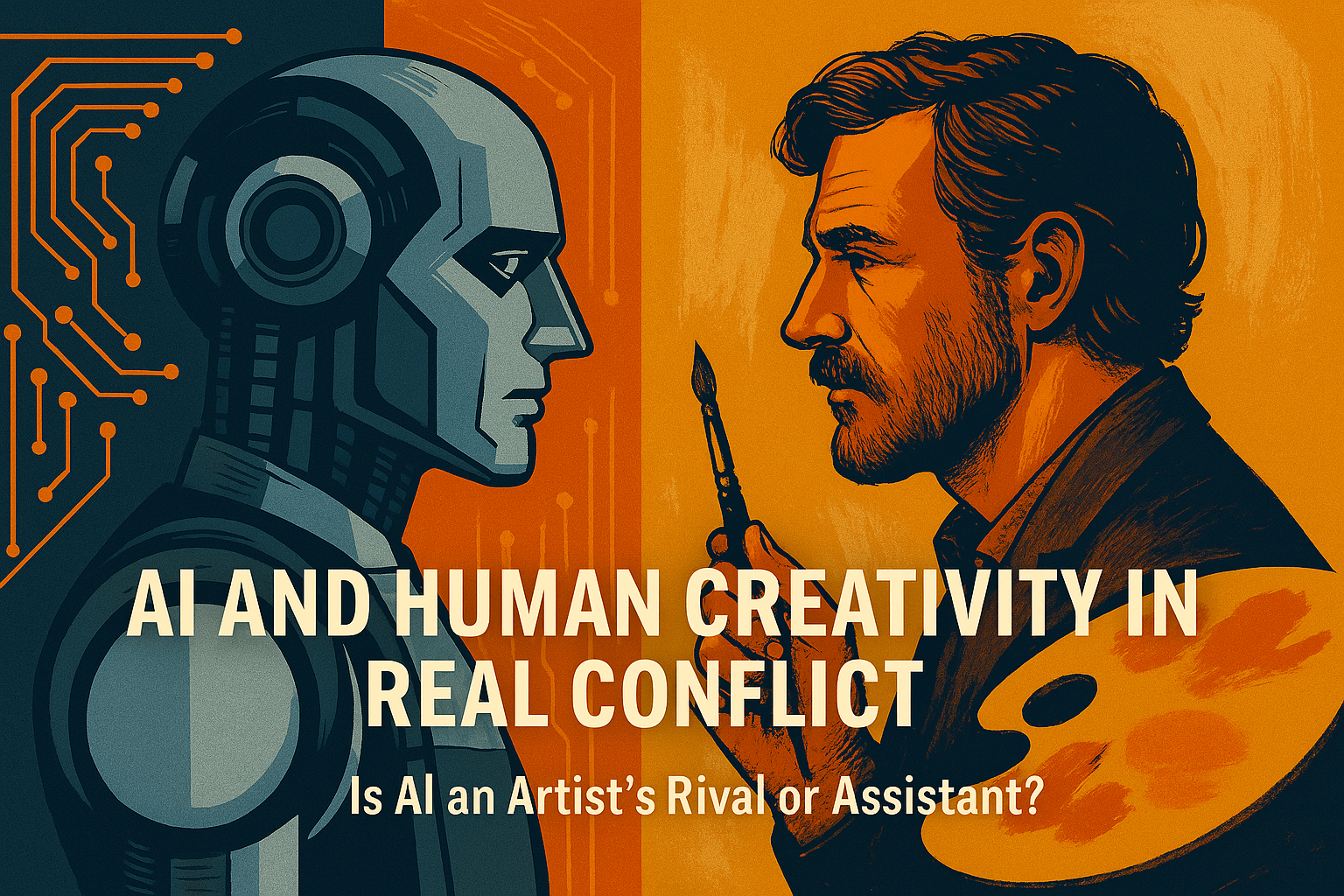

Generative AI has burst into the creative arena, bringing both excitement and angst across the art world. In 2024, artists, musicians, writers, and performers found themselves increasingly working alongside algorithms—or competing against them. An AI-generated painting can now win a fine arts competition, an algorithm can compose a pop song imitation that goes viral, and a computer-written story can flood a publisher’s inbox. These are no longer futuristic what-ifs; they are happening today. This rapid emergence of AI in creative fields has ignited a worldwide debate: Is AI a rival threatening human artists’ livelihoods and the soul of art, or a collaborative tool that can elevate human creativity to new heights?
This question matters to more than just artists. Culture and creativity touch everyone. If algorithms can produce convincing art and media, we all have a stake in how that transforms the books we read, the music we hear, the movies we watch, and the images we scroll past daily. The clash between AI and human creativity is not a distant philosophical musing—it’s a practical challenge unfolding right now. How we navigate this will shape the future of creative industries and, ultimately, the experiences of audiences worldwide. In this post, we delve into real-world examples from 2024–2025 of generative AI’s impact on visual art, music, literature, and performance. We’ll compare what AI and human creators each bring to the table in terms of originality, speed, and emotional depth. We will also examine the very real ethical and legal battles now being waged, from courtroom showdowns over AI-generated images to new laws protecting performers’ voices. Throughout, we incorporate the voices of artists and industry insiders who have hands-on experience with these tools. The goal is to move past hype or doom-and-gloom, and get to a realistic understanding of how AI is reshaping creativity today. By the end, we’ll outline a grounded forecast for the next 2–5 years—offering insight into whether AI will ultimately stand as the artist’s competitor or collaborator (or perhaps both), and how creators and society can adapt in this new creative era.
Generative AI Enters the Arts: 2024–2025 Case Studies
Generative AI’s influence swept across virtually every creative field in the past two years, producing dramatic firsts and forcing reckonings in each domain. Here are some of the recent real-world case studies that show the scope of AI’s incursion into creative industries:
- Visual Art – From Canvases to Code: In galleries and online art communities, 2024 was the year AI art went from novelty to mainstream discussion. One landmark moment actually traces back to 2022, when an AI-generated piece titled “Théâtre D’opéra Spatial,” created via the Midjourney image generator, won a digital art competition at the Colorado State Fair. The victory of that ethereal portrait (which fooled judges and beat human artists) sparked an outcry that continued into 2024. The artwork’s creator, Jason M. Allen, had openly disclosed his use of AI, which only fanned the debate: was it “cheating” or simply a new form of creativity? By 2024, the ripples of that event turned into legal waves – Allen found himself fighting the U.S. Copyright Office for refusing to register his AI-assisted image as an original work. The authorities argued that because a machine generated the visuals, it lacked the human authorship needed for copyright. In September 2024, Allen sued in federal court to claim authorship, asserting that the creative choices (from crafting hundreds of prompts to fine-tuning the output in Photoshop) were his and not the algorithm’s. This unprecedented case highlights the new question society must answer: can something crafted with significant human guidance yet largely rendered by an algorithm be considered “human” art in the eyes of the law? But legal battles are just one side of visual art’s collision with AI. On the industry side, many artists initially responded to text-to-image tools with alarm as they saw online generators churn out endless imitations of real artists’ styles. In early 2023, a trio of illustrators sued AI companies behind popular image generators, accusing them of training on millions of online art pieces (including the illustrators’ own distinct works) without permission. Their class-action lawsuit argued this was effectively mass copyright infringement and theft of style. Fast-forward to August 2024: in a landmark ruling, a U.S. judge acknowledged the validity of these concerns, allowing the case to move forward and noting that the way generative models store and reproduce images could indeed violate artists’ rights. This was heralded as a major victory by human artists, signalling that courts might not give AI a free pass to appropriate human creations wholesale. Even as these fights continue, generative AI kept penetrating visual arts through more collaborative avenues. Major creative software firms integrated AI as a tool: for instance, Adobe’s Photoshop now offers a “generative fill” feature (powered by its Firefly AI) that lets designers magically extend images or remove objects in seconds, tasks that used to take much longer by hand. Many illustrators and graphic designers embraced these new powers. Social media is rife with concept artists showing how they use Midjourney or DALL·E not to replace their work, but to brainstorm concepts and overcome creative blocks. An artist can generate dozens of rough ideas for a scene or character using AI, then pick the best one to refine in their own style. In fact, surveys in 2024 found that 65% of visual artists had experimented with text-to-image AI to spark new ideas for their projects. Take digital illustrator Egor Golopolosov as an example: he began using Midjourney to generate reference images and quirky inspiration for his pieces. “From my point of view, AI is not a replacement for artists but rather an assistant,” Golopolosov said, describing how clients even started providing AI mock-ups of their vision to communicate better with him. This kind of collaborative usage indicates that many artists see generative AI less as an enemy and more as a powerful addition to the creative toolbox. Still, not everyone is convinced – a 2024 poll showed 76% of general art audiences do not consider AI-generated works to be “art” in the true sense, often because they feel it lacks the “soul” or intent of a human creator. In short, the visual art world in 2024 was a patchwork of experimentation and resistance: AI creations hung in respected galleries and won prizes, even as human artists took to the courts and social media to defend the integrity and ownership of their craft.

AI-generated artwork “Théâtre D’opéra Spatial” (Jason M. Allen, 2022) – created with Midjourney – which won a state art fair competition. Its victory ignited debate about the role and authenticity of AI in art. In 2024, the artist fought for its copyright, highlighting how legal systems are grappling with AI-authored works.
- Music and Audio – Ghosts in the Machine: The music industry also experienced a whirlwind of AI-driven creativity and conflict in 2023–2024. Perhaps the defining incident was the rise of the mysterious producer known only as “Ghostwriter.” In early 2023, Ghostwriter released “Heart on My Sleeve,” a catchy hip-hop track that became a viral sensation online. The twist? The song’s vocals were AI-generated imitations of superstar artists Drake and The Weeknd, who had absolutely nothing to do with the track. Fans were stunned at how convincingly the AI reproduced the performers’ voices and style; many thought it was a leaked collaboration at first. The track racked up millions of listens on TikTok and YouTube within days – and equally swiftly, it was pulled down after Universal Music Group intervened, citing intellectual property rights. This deepfake duet demonstrated both the creative possibilities and the ethical quagmire of AI in music. On one hand, a completely unknown creator managed to produce a song that captivated audiences by “collaborating” with digital replicas of famous voices. On the other hand, it was done without those artists’ consent, raising alarms across the industry about impersonation and copyright violation. By 2024, the fallout from “Heart on My Sleeve” had grown into concrete action. In the United States, the home of country music became an unlikely leader in AI regulation: Tennessee passed the first law explicitly to protect singers and musicians from AI forgeries. Dubbed the “ELVIS Act” (a fitting acronym for Ensuring Likeness Voice and Image Security), the law was enacted in early 2024 and makes it illegal to use someone’s likeness or voice in an AI-generated performance without permission, targeting exactly the kind of situation Ghostwriter created. At the signing of the bill, music executives and even some country artists stood by the governor, underlining how urgent the issue had become for performers. The Recording Industry Association of America (RIAA) lauded the move, with its CEO calling it essential for “protecting an artist’s soul”—in other words, ensuring that a musician’s unique voice and identity cannot be commercially exploited by algorithms as a mere plaything. Meanwhile, record labels and streaming platforms also scrambled to address the influx of AI-generated songs. In mid-2023, Spotify quietly removed tens of thousands of tracks that had been uploaded by AI music startups flooding the service with computer-composed songs. This was partly to combat potential spam or royalty gaming, but also a recognition that an uncontrolled flood of AI content could overwhelm human-made music discovery. Tech companies are equally involved: on the positive side, Google’s research division has been working on AI music generation (like the MusicLM project), though they withheld public release out of concern for copyright issues. And in a more collaborative spirit, pop icon Grimes made headlines by inviting her fans to create AI-generated music using her voice, offering to split royalties 50/50 for any successful song. By mid-2024, she even launched a platform (Elf.tech) to officially facilitate these AI voice collaborations. This experiment suggests one possible future where artists “open source” their voice or style to co-create with AI and fans—flipping the script so that it’s done with permission and partnership, not via unauthorized mimicry. On a larger scale, AI music tools have become commonplace in production studios. Producers now use AI to generate instrumental backing tracks, alter vocal styles, or master recordings. Need a hundred variations of a synth melody? Or a quick demo vocal in the style of Adele to see how a song might sound? It’s increasingly possible at the click of a button. In the indie scene, some video game and film composers use AI software to churn out mood music or soundscapes on tight budgets. However, the reception from musicians remains mixed. Many performers are understandably anxious—will AI compositions replace the need for human songwriters? Will virtual singers take jobs from session vocalists? Those fears aren’t unfounded: a global study in late 2024 predicted that by 2028, around 24% of music creators’ revenue could be at risk due to generative AI’s proliferation, as synthetic tracks potentially siphon listeners and licensing opportunities from human-made music. At the same time, plenty of artists are finding that AI can be a creative jamming partner. In 2024 we saw AI assist human musicians in novel ways, like analyzing decades of a band’s back-catalog to suggest new riffs in their signature style, or helping a songwriter quickly transmute a hummed tune into various instruments. Renowned singer-songwriter Nick Cave, known for his emotive, literary lyrics, famously experimented with ChatGPT in late 2023 and (quite bluntly) declared its songwriting attempts awful – saying it had no feelings and therefore its songs were “a grotesque mockery of what it is to be human.” His sharp critique went viral, reflecting a common sentiment among many artists that music, at its core, is an expression of human experience that an algorithm just can’t replicate. Yet, other musicians take a more pragmatic view: repetitive or formulaic tasks in music production (say, generating a basic drumming pattern or a dozen chord progressions to try out) can be offloaded to an AI, freeing the human artist to focus on inspired melody or lyrics on top of those foundations. In short, the music world in 2024 is grappling with AI on two fronts: protecting artists’ identity and creativity from unauthorized cloning, and embracing AI’s assistance in the creative process where it makes sense. From the legislation in Nashville to experimental albums composed with neural networks, it’s clear that AI is now a permanent part of the soundtrack of the industry – the question is how harmoniously it will play along with humans in the long run.
- Literature and Media – A Flood of Words: Writers have not been spared the AI upheaval. The release of advanced language models like GPT-4 brought the capabilities of AI writing to a new level in 2023, and by 2024, we’ve seen both promising uses and alarming abuses in the world of words. On the promising side, some novelists and journalists use AI as a sort of writing assistant. For instance, an author might employ a tool like ChatGPT to help brainstorm plot ideas or overcome writer’s block (“What might a detective notice in a crime scene set in a greenhouse?”), treating the AI as a clever prompt machine. Some writers have co-written fiction with AI: one high-profile experiment was “Death of an Author,” a novella published in 2023 where the human author, Stephen Marche, generated prose via AI and then edited it into a coherent literary piece. Marche described the process as something between collaboration and curation. Similarly, screenwriters have toyed with AI to punch up dialogue or generate variations on a scene. However, professional writers are also drawing red lines. In Hollywood, the Writers Guild of America (WGA) went on strike in 2023 partly over fears that studios would try to use AI to draft scripts or storylines without proper writer involvement. The resulting new contract (ratified in late 2023) explicitly bars AI from being credited as an author and ensures that any AI-generated material must be treated as a tool, not a replacement—writers cannot be forced to use AI, and scripts can’t be based on AI drafts to avoid paying the human writers. Essentially, the guild pushed through the message that you need a human writer in the loop, period. This was a critical stance to make early, as studios had indeed been exploring AI for things like summarizing books into screenplay drafts. On the print publishing side, AI deluges became a real headache in 2024. Several science fiction magazines (which often accept submissions from new authors) had to shut down story submissions temporarily because they were swamped by hundreds of AI-generated short stories sent in by opportunists hoping to get published. The magazine Clarkesworld was one of the first to raise the alarm: its editor noticed a sudden spike in gibberish, formulaic stories that bore the telltale signature of AI text. It got so bad that they closed submissions and implemented new filters and author verification steps. Likewise, Amazon’s Kindle self-publishing platform saw an influx of low-quality, AI-written e-books on its store, from get-rich-quick guides to ersatz romance novels, often under fictitious author names. This glut of machine-made content prompted the Authors Guild (the US’s largest writers’ organization) to act: in mid-2024 they launched a “Human Authored” certification program. This voluntary label allows authors to vouch that a given book is “emanated from human intellect” with no AI ghostwriters, aiming to reassure readers and maintain a zone for human creativity. In parallel, well-known authors from genres like fantasy and horror filed lawsuits against AI developers for training on their novels without consent. For example, authors Paul Tremblay and Mona Awad sued OpenAI after discovering text from their books in ChatGPT’s outputs, claiming that the AI’s dataset included pirated copies of their works. Such cases underscore a core literary concern: an AI that learns from millions of copyrighted books may end up spitting out passages uncomfortably close to the originals, blurring plagiarism lines. On the flip side, some publishers are cautiously exploring AI as a tool (for instance, to generate preliminary translations, or to summarize long manuscripts for internal review), but with strict human oversight. By the end of 2024, a kind of uneasy consensus was forming in publishing: AI can be a helpful assistant for editing and idea generation, but story, voice, and creative spark must originate from real human writers. Readership trends seem to support this—while AI-written content has proliferated in quantity, works clearly labeled or reputed as human-authored still carry a prestige and emotional impact that AI hasn’t matched. After all, part of what draws people to a novel or poem is the sense of a human soul behind the words, sharing insight or imagination born of real experience. That human touch remains literature’s bedrock, even as the industry builds guardrails to keep the waves of algorithmic content from eroding it.
- Film, TV, and Performance – Facing Digital Doppelgängers: Perhaps no sector saw a more viscerally felt clash between AI and human creatives in 2023–2024 than the screen acting and film production world. As audiences, we’ve grown familiar with digital effects resurrecting actors (like holographic cameos of long-dead stars) or de-aging them on screen. But generative AI takes it further: now an algorithm can potentially craft a “digital replica” of an actor – their face and voice – to perform new scenes they never actually did. In mid-2023, Marvel’s TV series “Secret Invasion” debuted with an opening credits sequence entirely generated by AI rather than a traditional design team. The psychedelic, shape-shifting imagery (meant to fit the show’s themes of impersonation) instead became a flashpoint for backlash. Many fans and artists on social media criticized Marvel/Disney for choosing an AI-driven approach, seeing it as taking work away from human title designers and VFX artists. The studio clarified that no jobs were lost (the AI imagery was created by a VFX company specifically tasked with it), but the symbolism was potent: even at the highest levels of Hollywood, AI was encroaching on creative roles. This controversy hit right as the Hollywood writers’ and actors’ strikes were underway, making it something of a cautionary tale in the negotiations. Indeed, the Screen Actors Guild (SAG-AFTRA) strike of 2023, much like the writers’, hinged significantly on AI issues. One of the most striking concerns was a proposal from studios to scan background actors (extras) digitally, pay them for one day, and then have the freedom to reuse their likeness via AI indefinitely in any film without additional pay. To the actors’ union, this sounded like a dystopian scenario ripped from science fiction: studios potentially populating scenes with unlimited “virtual extras” and never hiring those people again. It galvanized the actors to demand protections. When the strike concluded in late 2023, the new contract included groundbreaking rules for AI usage. Now, studios must obtain explicit, informed consent from actors for any creation of digital replicas of their likeness, and such use must be compensated and limited to the agreed context. In simpler terms: no, a studio cannot just create a synthetic Tom Cruise or Scarlett Johansson and use that AI clone in future movies without the actor’s approval and involvement. Even for unknown actors, if a “digital extra” is made, it’s bound by contract terms and pay. The contract also acknowledged fully AI-generated performers (sometimes called “virtual actors”) and set a precedent that if an AI character is going to replace what would otherwise be a human role, the union must be consulted and compensation negotiated. These measures were heralded by actors as a survival safeguard for their profession. Prominent actors spoke out during the strike with rallying cries like “We won’t be replaced by machines.” The direct, physical nature of an actor’s work – their face, body, and voice – made the threat of AI very personal. It’s one thing for AI to write a few lines of dialogue, quite another for it to puppeteer a lifelike avatar of a performer. Outside the realm of labor disputes, filmmakers have been testing AI creatively too. Directors have used AI tools for storyboarding and pre-visualization, generating rough animated versions of scenes before shooting them with actors – a process that, when done by humans, is time-consuming and costly. Some independent filmmakers even experimented with AI-generated actors for minor roles or used AI voice dubbing to quickly translate their films into other languages using the original actors’ voices (synthesized in different tongues). These experiments remain on the fringes due to ethical as well as quality issues (fully AI-generated acting still falls into the “uncanny valley” often – not quite convincingly human in performance). Live theater and dance saw novel collaborations, where AI systems controlled stage lighting or even robotic performers that respond to the live actors. In one avant-garde performance in 2024, a dancer performed an intricate duet with “Spot,” the yellow robot dog made by Boston Dynamics, its moves partially guided by an AI vision system reacting to the dancer’s motions. This kind of human-AI choreography blurs the line: the robot isn’t replacing the dancer, but partnering with her in a way that simply wouldn’t be possible without AI. It’s a compelling vision of augmentation rather than replacement.

A human dancer performing alongside Boston Dynamics’ Spot robot (an AI-driven mechanical performer) in an experimental arts showcase. Such collaborations highlight that AI in performance can be more than a mere threat — it can enable creative expressions where machines and humans each do what they do best on stage, offering audiences a novel hybrid spectacle.
As of 2025, the public’s reception of AI-driven media remains a mixed bag. Audiences marvel at the technical wizardry – for example, surprise appearances of deceased actors via AI in movies can generate buzz and nostalgia. But there is also growing pushback and a desire for transparency. Viewers increasingly call for AI-generated characters or significant AI usage in media to be disclosed. In fact, upcoming regulations (such as the European Union’s draft AI Act) are likely to require that AI-generated content in audiovisual media be clearly labeled to avoid deception. All told, the performing arts and entertainment industry has confronted the AI revolution perhaps most head-on: through strikes, new contract clauses, experimental art, and public debate. Creators in this space are drawing lines around human creativity and labor, even as they begin to integrate AI as a high-tech collaborator under careful conditions.
AI as Rival or Collaborator? A Comparative Analysis
Given these diverse cases, it’s evident that AI can be either a **“rival” to human creators or a **“collaborator,” depending on how it’s used. Let’s break down the comparison across a few key dimensions – creativity, speed, emotional depth, and public reception – to see where AI stands versus human artists today:
Creativity and Originality
Humans are renowned for our creativity – the ability to generate truly original ideas inspired by emotions, experiences, and conscious imagination. Human artists draw on cultural context, personal narratives, and sometimes seemingly random epiphanies to create works that can surprise and move us. AI, by design, is derivative: it learns from existing data (artworks, songs, text) and creates based on patterns in that training material. This means AI’s “creativity” is fundamentally one of recombination and imitation. An AI image generator, for instance, can output an infinite variety of images in the style of Impressionism if trained on Monet and Renoir; it excels at style mimicry. It can even mix and match – producing, say, a surreal cityscape that blends Van Gogh’s brushstrokes with Picasso’s cubist forms. What it cannot easily do is generate something truly outside the box of its training. AI lacks the intent and self-awareness that fuel human innovation. It doesn’t “decide” to subvert artistic norms or convey a specific message; it has no message at all, other than what its prompt or training implies. On the other hand, AI’s pattern-crunching prowess means it can produce outcomes that feel novel simply by virtue of combining inputs humans might never think to merge. The classic example is all the oddball prompt images people love to make: “astronaut riding a horse on the moon in Renaissance painting style,” for instance, as we saw earlier. No single Renaissance artist painted that, but an AI can synthesize it convincingly, which feels creative. The reality is that it’s remixing learned elements (space suit + horse + lunar landscape + oil painting techniques) in a new juxtaposition. Many human artists would argue this is more pastiche than true creativity. Yet, some AI-created pieces do strike viewers as innovative. Why? Often it’s the human user’s input that provides the spark – the clever prompt or the curation of outputs. In collaborative settings, artists treat the AI like a chaotic creative partner tossing out ideas; sometimes the machine’s lack of inhibition (it doesn’t know an idea is “silly”) results in a fresh artistic approach the human might not have arrived at alone. In summary: As a “rival,” AI often falls short of human originality – it feeds on human-created styles and ideas, so without those it has nothing. But as a “collaborator,” AI can inject a torrent of variations and options that spur human creators to explore paths they hadn’t considered. We might say humans still lead in pure creativity, while AI offers amplified ideation.
Speed and Productivity
On raw speed and volume, AI is an absolute beast. What might take a team of animators weeks of work – say designing hundreds of background characters for a crowd scene – an AI could potentially generate in minutes once properly set up. Need a logo design? An AI service can give you 20 decent concepts in the time a human designer sketches one or two. Speed is where AI is unequivocally a powerful competitor. In fields like graphic design, advertising, and even content writing, this is causing a reevaluation of workflows. Companies find that routine creative tasks (producing variations of an image, generating template-based articles, etc.) can be drastically accelerated with AI. For example, a marketing firm might use AI to generate dozens of banner ad mockups and then have a human art director pick and refine the best. The turnaround time for client visuals shrinks from days to hours. Human artists and writers simply can’t compete with the tireless, instant output of algorithms on rote tasks or high-volume needs. However, speed is not everything. In creative work, quality and thoughtfulness matter enormously. An AI may whip up 100 ideas in a blink, but if 95 of them are mediocre or off-target, a human expert who produces 5 well-honed ideas might still be more efficient in practical terms. That said, for many commercial art needs, AI’s productivity is a massive advantage. It is no coincidence that by 2025, companies like Canva and Adobe (which cater to everyday content creators and professionals alike) heavily feature AI tools – users expect that rapid-fire ideation and editing will be available at their fingertips. From a rivalry perspective, this speed means AI is outcompeting humans in quantity. A single AI art generator can replace what would have been multiple junior designers doing repetitive production work. From a collaboration angle, the speed means human creators can iterate faster. They can offload the grunt work to AI and spend more time on the high-level creative decisions. In industries like architecture, for instance, an architect can have AI churn out numerous floor plan variations while they quickly evaluate and tweak, exploring far more options in the early design phase than previously possible. The net effect: if used wisely, AI’s speed can augment human productivity tremendously. But if used as a pure replacement for human labor in pursuit of efficiency, it becomes a formidable rival, potentially displacing roles that were essentially about producing quantity (think junior graphic artists tasked with churning out web advertisements all day – a task an AI can now largely handle).
Emotional Depth and Authenticity
Here is where humans arguably hold their strongest ground. Great art, music, and literature resonate with us because they carry emotional weight – they often channel the lived experiences, feelings, and viewpoints of their creators. When you listen to a heartfelt song written by someone going through heartbreak, you often feel the authenticity. When you stand before an oil painting that the artist spent months agonizing over, you sense the intent and emotion imbued in every brush stroke. Can AI replicate this? At a surface level, it can mimic the appearance of emotional art. It can write a poem about loneliness that uses all the right words and metaphors, because it’s seen those in human-written poems. It can compose a melody that sounds mournful, because it mathematically knows which chord progressions evoke sadness in most listeners. But the crucial difference often noted by critics is the lack of underlying intent or story. AI has no consciousness; it feels nothing, fears nothing, loves nothing. It cannot truly suffer or rejoice. Thus, when it creates an artwork, there is arguably no “someone” behind it experiencing those emotions. Audiences often intuit this gap. For instance, an AI-generated painting might be technically stunning and even evocative, but when people learn it was made by a machine, some report a sense of hollowness – as if the work is a beautiful shell without a soul inside. In 2024, an interesting experiment occurred in the literary world: a magazine published two short stories, one written by a human and one by AI, both on the theme of grief (and without telling readers which was which). Many readers correctly identified the human one, describing it as “more raw and intimate,” whereas the AI story, while impressively coherent, felt somewhat cliched and emotionally flat. This isn’t to say AI art cannot move people – it certainly can. A stirring AI-composed orchestral piece might still give someone goosebumps, especially if they don’t know it was AI. The emotional response of the audience is real, even if the creator had no emotions. But over time, there’s a risk of a perceptible generic quality to AI-generated emotional content. Because AI draws from common denominators of what it has seen, it might trend toward the sentimental or formulaic expression of feelings. Public reception reflects this: many art lovers and music fans assert that they value the human story behind the art as much as the art itself. They want to know the painter struggled with depression and poured it into the canvas, or that a singer lived the experiences in their lyrics. With AI, there is no life story – unless one is artificially assigned to it as an illusion. As a collaborator, AI can help human artists execute their emotional vision. For example, if a filmmaker wants to convey a very specific mood in a scene, they might use an AI tool to generate numerous color grading styles or background scores until they hit the feeling that matches the director’s intent. The human is still steering the emotional ship; the AI is just supplying options. As a rival, however, AI’s lack of true emotional understanding is a ceiling it may not overcome unless we ourselves begin to value end-products more than process. It poses a provocative question: If an AI-created song makes you cry, does it matter that the AI doesn’t know what tears are? Some pragmatists would say art’s effect is what counts, not the creator’s identity. But for many, the notion that art is a fundamentally human-to-human communication remains paramount. In that sense, humans maintain an edge in genuine emotional depth, at least for now.
Public Reception and Cultural Impact
Public opinion on AI in the arts is deeply divided and continually evolving. On one side, we have growing fascination and acceptance: as generative AI creations proliferate, many people are wowed by what these tools can do. A 2024 survey across several countries showed that about 30% of respondents felt AI-generated art can be “just as good” as human art, and a similar fraction viewed AI as a positive innovation in creative fields. Particularly among younger, tech-savvy audiences, there is an openness to AI-crafted entertainment. They see it as just another technological evolution, not fundamentally different from synthesizers changing music in the 80s or Photoshop altering photography. Some consumers appreciate the personalization aspect that AI can offer – for instance, people have used AI to commission “art” of their RPG characters or get a custom lullaby generated for their child. This sort of bespoke creative content was inconceivable at scale before AI; now it’s a novelty that could become normal.
However, a significant portion of the public harbors skepticism or even hostility toward AI in creative domains. The initial excitement often gives way to a feeling of “something is missing”. In the same 2024 polls, a clear majority (well over 60%) said they do not consider AI outputs to have the same legitimacy as human-made art. Many explicitly stated that AI works shouldn’t compete with human works in contests or be displayed without context, because it’s not a fair comparison or because they don’t view the AI’s output as true “authorship.” When an AI-generated photograph won a prestigious photography prize in Germany in 2023 (the artist who submitted it revealed after winning that it was AI-made, and he actually declined the award), it sparked outrage and soul-searching; by 2024, many art contests and magazines had updated their rules to either ban AI-generated submissions or require clear labeling. There’s also a sense of fatigue: with so many AI images and texts flooding the internet, some people feel we might drown in content that all looks and reads kind of the same. It’s notable that only about 8% of professional artists said they would willingly exhibit AI-generated pieces in a gallery setting. That indicates that even if they dabble in AI for fun or utility, artists largely still separate it from their serious “fine art” work intended for public appreciation.
Culturally, human-created art still sets the trends and carries the symbolic weight. No AI artwork has yet achieved the iconic cultural status of, say, Beyoncé’s album Lemonade or a Nobel-prize-winning novel – and perhaps the public wouldn’t allow it to, at least not without a human face to attach it to. Instead, AI is currently often seen as reflective or even derivative of the culture we already have. It’s great at generating fan fiction or images “in the style of X.” It’s like a mirror with a million filters, rather than a torch lighting the way to the next cultural movement. Of course, these perceptions could change. Each new generation grows up with technology differently. By 2025, we even have teens who’ve grown up writing stories with AI co-authors or making artwork with apps like Midjourney on their tablets. To them, the line between AI and human creativity might feel less important – it’s all just creativity. But for now, public reception is cautious: there’s intrigue and enjoyment of what AI can do, but also a conscious valorization of human-made art as something special. This is evident in trends like the resurgence of interest in handmade crafts, live concerts, and original fine art – experiences guaranteed to be human. In response to AI’s rise, many consumers and creators double down on the value of the human touch as a distinguishing factor. Rather than AI and human art blurring together, we might see a clearer bifurcation: AI for quick, utilitarian creative needs; human artistry for depth, authenticity, and cultural significance.
Comparison: Human vs AI Creativity at a Glance
To synthesize the above analysis, here’s a comparison table highlighting how human artists and AI stack up against each other on key criteria:
| Criteria | Human Artists | AI Creators |
|---|---|---|
| Originality & Ideas | Excels at true originality, inspired by personal experiences and conscious intent. Can intentionally break rules and create new styles. | Generates content by remixing learned patterns from existing data. Can appear inventive by combining concepts, but lacks genuine intent or self-driven innovation. |
| Speed & Volume | Limited by human effort and time – often require hours or days for one piece or iteration. Quality can be high but output quantity is constrained. | Unmatched speed – can produce dozens of images, songs, or pages of text in minutes. Great for rapid prototyping and high-volume tasks, though may need curation for quality. |
| Emotional Depth | Embeds real human emotion, story, and perspective into art, which many audiences find deeply authentic and relatable. Capable of symbolic meaning and soulful imperfections that resonate. | Mimics emotional tone based on data (e.g., using “sad” minor chords or poignant words). Can evoke emotion in audience, but there is no true emotional understanding or lived experience behind it, which some argue limits its authenticity. |
| Consistency & Precision | Skill level can vary; artists have unique styles and sometimes unpredictable output. Consistency improves with experience, but humans can have “off” days or intentional variability. | Extremely consistent in style/quality once trained – can apply the same style uniformly at scale. Maintains precision in following given instructions (prompts) without fatigue or deviation (unless randomness is introduced by design). |
| Adaptability & Learning | Highly adaptable through conscious learning – can jump between styles or mediums with training and effort. Brings cross-disciplinary creativity (applying experiences in one art form to another). | Very adaptable within its training scope – can instantly switch styles or genres it has learned. However, bound by its training data (needs new training to learn truly new concepts) and lacks common sense understanding beyond patterns. |
| Cost & Resources | Creation can be labor-intensive and costly (years of training, fair compensation needed for time). High-end art or live performance is not easily scalable without significant resources. | After initial model development, producing additional content is low-cost and fast. Reduces need for large teams on repetitive tasks, making production more “scalable”. However, top AI models themselves require significant computing resources and investment to develop/maintain. |
| Cultural Reception | Viewed as authentic creators; their work often gains value from the human story and effort behind it. Mistakes or limitations can even endear audiences (the “human element”). | Viewed with fascination but also suspicion; often seen as tools rather than authors. AI-made works may be judged more on output merit alone, but lack of a human identity can limit cultural impact or acceptance in serious art circles. |
Table: A comparison of human and AI creative contributors across several dimensions. While AI outperforms in speed, scale, and stylistic consistency, human creators hold advantages in originality, emotional expression, and cultural authenticity. In practice, the best results may come from combining strengths—using AI’s efficiency and breadth with human guidance and heart.
User Experience: Creators on Using AI Tools
The real experts on AI’s role in art are the creators experimenting with it every day. Their experiences reveal the technology’s current strengths and limitations in practice. Let’s hear from a few artists and industry professionals, across different creative fields, about how working with generative AI actually feels:
- The Digital Illustrator – “AI as my brainstorming buddy”: We’ve already introduced Egor Golopolosov, a seasoned illustrator who has worked with brands like Disney and Coca-Cola. Egor began integrating AI into his workflow in 2023. He uses Midjourney to generate quick visual references and concept sketches when a client presents a new idea. For example, if tasked with drawing a fantastical cityscape, Egor might spend an hour prompting the AI for various compositions – flying buildings, wild color schemes, different perspectives – and get back dozens of images. He picks a few intriguing ones as inspiration and then hand-draws his actual piece, informed by those ideas. “It’s like firing off a bunch of imagination rockets and seeing where they land,” he says. The AI often produces visual arrangements he wouldn’t have thought of on his own. Egor emphasizes that he does not simply deliver the AI image to clients – in fact, he often heavily redesigns the final artwork in his own style. The AI’s output is just raw material. “AI is not a replacement for artists but rather an assistant,” Egor told an interviewer. He notes one caveat: sometimes the AI results are so polished that it’s tempting to rely too much on them. He has to remind himself to push beyond what the machine suggests. Overall, his experience is positive – by saving time on rough drafts, AI lets him focus more on the creative decisions that matter, and deliver projects faster. Clients have responded well to the faster turnaround, and as long as he’s transparent (in internal process, not necessarily to the public) there’s no issue. Egor does support clear labeling of AI-involved art in the public sphere, believing that audiences have a right to know “Made by AI” just as they would want to know the medium or techniques used in any art piece.
- The Concept Artist & Activist – “Protecting our style and our jobs”: On the flip side, Karla Ortiz, a prominent concept artist (with work for Marvel films and major game studios), has emerged as a vocal critic of current AI art practices. Karla’s own distinctive fantasy illustrations were among those scraped into AI training sets without her consent, which she discovered when bizarrely similar images in her style started popping up online tagged #midjourney. For Karla, trying out these tools herself was a disconcerting experience: “I typed my name into one of these generators, and it spit out something that looked like a warped imitation of my work. It was horrifying – like looking into a funhouse mirror.” Far from viewing AI as a helpful collaborator, she saw it as “replacement tech” being deployed by companies without regard for artists’ rights. She helped spearhead the aforementioned class-action lawsuit against the makers of Stable Diffusion and Midjourney. While she acknowledges the underlying technology is impressive, her experience leads her to fight for ethical reforms: “If I choose to use AI in my process, that should be my choice and done with my input data. I can’t accept a system that’s built on taking from artists wholesale.” Karla’s stance resonates with many in the art community who feel fear and anger that AI may undercut their careers. She points out that some companies have already quietly downsized certain art departments, not hiring new junior artists because AI can fill the gap for basic concept art or background assets. Her own workflow now includes explicitly avoiding AI except for minor tasks, out of principle. Instead, she’s channeling energy into advocacy – pushing for things like opt-out mechanisms (so artists can exclude their works from AI training datasets) and legal recognition that an artist’s style is part of their intellectual property. Karla’s experience underscores a critical reality: not all creators feel empowered by AI; many feel threatened and exploited, especially when they have no control over how their past works are used by algorithms.
- The Music Producer – “Breaking through creative blocks”: Across the aisle in music, John (a pseudonymous producer working with an indie label) has been using generative AI tools to spice up his compositions. John produces electronic pop, and in 2024 he started experimenting with an AI music generator to create instrumental layers. “Sometimes I just hit a wall coming up with a fresh hook or bassline,” he explains. Now, when inspiration is low, he can input a simple melody into the AI and ask it to generate variations in different genres or moods. He might get back a synthwave version, a tropical house riff, even a classical piano interpretation. Most of it he won’t use directly, but occasionally the AI plays something that makes him go “Oh that’s cool, I hadn’t thought of that rhythm.” He’ll then reproduce a similar pattern with his own tweaks, effectively co-writing with the AI. John likens it to having an “infinite session musician” who can jam ideas at any hour. One track on his latest EP actually features a short AI-generated vocal harmony in the background. He used a vocal synthesis model trained on choir samples to create an ethereal harmony that would have been hard to get otherwise (hiring a choir for a small segment was out of budget). He did worry: would listeners react negatively if they knew? To test it, he posted two versions on a private forum – one with the AI choir, one without – and got feedback. Listeners overwhelmingly preferred the version with the AI vocals, describing it as “haunting” and “otherworldly.” When John revealed the vocals were AI, most were surprised but didn’t mind, saying it was just another instrument. However, a couple of commenters felt it “cheapened” the song knowing that element wasn’t human. For John, the user experience of AI in music has been liberating creatively, but he remains cautious about credit and ethics. He always discloses AI usage in the production credits (in part to be transparent, in part to preempt any later issues if an AI-generated portion coincidentally resembles someone else’s copyrighted music). He also mentions that using AI hasn’t replaced any people he’d otherwise work with – “It’s not like I’d have hired backing vocalists for that part; the AI allowed something new to exist that otherwise wouldn’t.” That perspective highlights that in some cases AI can augment what independent creators can achieve with limited resources, rather than simply being a tool for big studios to cut costs.
- The Film Animator – “Faster grind, uncertain quality”: In an animation studio context, Priya, a junior animator at a mid-sized studio, shares a more measured experience. Her studio started using an AI in-betweening tool in 2024. In traditional animation, senior artists draw key frames and junior animators draw the in-between frames to create smooth motion – a painstaking task. The AI tool can automatically generate many of those in-between frames. Priya recalls her mixed feelings: “Part of me was relieved – that grunt work got lighter. But part of me thought: is the AI going to get better and eventually do all the in-betweens, leaving me nothing to do or learn from?” Initially the tool was far from perfect; she spent a lot of time cleaning up its output. It would introduce weird distortions in character movement that she had to fix. Over months, as the software improved, it required less correction. By late 2024, she estimated the AI saved her about 30% of the time she used to spend on in-between drawings. The studio didn’t let anyone go, but it did allow each animator to handle more scenes than before. The quality of life improvement is real – fewer late nights, and she can focus more on refining the key poses and adding creative flourishes. However, Priya notes a subtle drawback: “I’m not drawing as much frame-by-frame, so I worry my own hand-drawing skills aren’t growing as fast as they would have.” In essence, by leaning on the AI, the juniors might lose some traditional training opportunities. It’s a classic technology trade-off. From a user perspective, Priya appreciates the tool but hopes the studio continues to rotate them through tasks that build their artistry, not just oversight of AI. She also mentions how management is already eyeing other AI tools for things like background design and even simple storyboarding. The workplace sentiment is cautiously optimistic – they see AI as a way to compete with bigger studios by increasing output, but there’s an underlying anxiety: will the studio start expecting far more work in the same hours now that AI provides a boost? This reveals another common user experience across industries: AI can increase pressure to deliver more, not just free up time. The human workload might remain heavy; only the expectations scale up. Creators like Priya are navigating this carefully, voicing that AI’s efficiency gains should ideally be used to improve work-life balance or creative quality, not simply to squeeze in double the work.
- The Company’s Perspective – “Empowerment with a learning curve”: From the company side, many organizations adopting AI creative tools report a mix of productivity gains and training challenges. A design agency that integrated DALL·E 3 for generating quick ad visuals found that new possibilities opened up for their clients – they could prototype campaigns incredibly quickly. However, the agency’s creative director noted that prompt engineering became a skill they had to cultivate: “It’s not like anyone can type a sentence and get a perfect ad image. Our designers spent weeks learning how to coax the AI into producing something usable.” They treated AI like a new intern: initially ignorant, needing guidance. Over time, the team built a prompt “library” of tricks for consistent results. Junior designers who mastered this saw their value in the company rise (a sort of new specialization), while a few senior designers who were less tech-inclined grew frustrated with the AI’s quirks (like its tendency to occasionally mangle hands or text in images). The company invested in training sessions and even brought in an outside consultant “AI artist” to teach best practices. This points out a user reality: using generative AI effectively isn’t always plug-and-play; it often requires learning and adapting one’s workflow. Once over that hump, though, the agency claims their output volume and even creativity in pitches increased markedly. Interestingly, they also involved their clients in the AI process – sometimes running collaborative prompt sessions in workshops. Clients loved being part of creation in real-time (e.g., “Can we see it with a red background? How about add a cat in there?” and the AI generates it on the spot). This improved client satisfaction and engagement. So in this sense, AI became a collaborative medium even between the agency and clients. The user experience for the company is thus broadly positive: they feel empowered and more cutting-edge. But they caution that for final deliverables, human polish is still absolutely required. One exec put it bluntly: “AI gets us 80% of the way in 20% of the time. The last 20% – the subtlety, alignment with brand, and removing weird AI artifacts – still needs our human touch and hours.”
These testimonies illustrate that the reality of working with AI is nuanced. For some creators, AI is a thrilling collaborator that accelerates their creativity or expands their solo capabilities. For others, it’s an unwelcome competitor forcing them to defend the value of human-made art and navigate new ethical territory. Many find it’s a bit of both: a tool that, if controlled, can handle drudgery and spark ideas, but if unchecked, might devalue skills or flood the field with mediocre content. A throughline is that control and transparency make a big difference. Creators feel most positive about AI when they initiate and manage its use in their work, and when everyone (team, clients, audience) understands the role AI played. Frustration and fear arise when AI is imposed top-down or used covertly, making artists feel sidelined or deceiving audiences. In practice, a lot of creators are developing hybrid workflows, discovering which parts of their art they’re comfortable handing to AI and which parts they fiercely keep human. This process is ongoing, collectively, as industries establish norms. One thing is clear from the user perspective: AI is here to stay in the creative process. Ignoring it isn’t really an option if one wants to remain competitive or innovative. The choice is in how to harness it in a way that aligns with one’s creative values and goals.
Conclusion: A Realistic Outlook for the Next 2–5 Years
Looking ahead to the next few years (through 2025 and beyond), the intersection of AI and human creativity is poised to intensify, but also to mature. Based on current trajectories, here is a grounded forecast for the near future of AI in creative industries:
- AI becomes a ubiquitous creative assistant (with humans at the helm): Much as Photoshop or digital cameras are now standard tools, generative AI is likely to be a normal part of the creative toolkit by 2027. We can expect every major creative software to fully integrate AI features – from writing aides in word processors to image generators in design suites – such that using AI doesn’t feel like using a separate novelty app, but just another function (“generate fill,” “suggest melody,” etc.). Crucially, human creators will still be steering these tools. The immediate future isn’t one of AI completely replacing artists, but rather artists who know how to leverage AI outpacing those who do not. The job descriptions in creative fields are already subtly shifting to include “ability to work with AI” as a desirable skill. We’ll see new creative roles emerge, like AI art director, AI content curator, or prompt specialist, which reflect this synthesis of artistic sensibility and AI savvy. Rather than eliminating creative jobs, AI may change their nature – there might be fewer purely entry-level rote production roles, but potentially more roles for highly skilled creatives who can supervise AI outputs and add the necessary human touch.
- Quality over quantity (a human premium): As AI-generated content floods the world, there’s a strong chance that truly human-crafted art will become more prized for its rarity and perceived authenticity. Think of it like the rise of synthetic diamonds – they’re indistinguishable and cheap, which actually increases the allure of a naturally occurring diamond for certain buyers. Similarly, a painting obviously done by a human hand, or a live theater performance with flesh-and-blood actors, will hold a unique appeal as AI-made content proliferates elsewhere. In the next few years, we might see a bifurcation of creative markets: one for inexpensive, instantly generated, disposable content (like generic music for YouTube videos, quick logo drafts, AI-written business memos) – this market will explode with AI’s help. And another market for high-touch, human-authored, original works (fine art, prestige television, literature) – this market may actually grow in cultural importance. Audiences will continue to seek out the stories behind creations. If anything, transparency about a creative work’s origins will be in demand. We may find labels like “100% human-made” or “authored by a human without AI” becoming a selling point in some contexts, while in others, the blend is accepted. Interestingly, we may also celebrate collaboration stories: for example, an album where a renowned composer works alongside an AI might be marketed on the novelty and innovation of that partnership.
- Ethical and legal frameworks catch up: Expect the currently blurry lines to get sharper through official policies. By 2025–2027, several countries will likely enact regulations around AI-generated content. These may include requirements to label AI-generated works, intellectual property rules assigning ownership (likely to the human or company that directed the AI, not the AI itself), and data protection laws ensuring training datasets respect privacy and copyrights. The legal precedents being set now – like the U.S. courts leaning towards “no human authorship, no copyright” for purely AI works – will solidify. This could mean that works created with substantial AI help might only get copyright if a human can demonstrate significant creative contribution in the process. Companies behind AI tools will also likely implement more robust opt-in or opt-out systems for artists and rights holders when it comes to training data. We’re already seeing early moves: some stock image sites offer to compensate artists for use of their images in training, and some AI platforms allow creators to exclude their content from scraping. In a few years, using copyrighted style or likeness without permission will become riskier for AI developers due to these legal norms. So, the Wild West period is ending; professionalization and regulation will make AI a more accountable tool. This benefits human creators by addressing many of the current injustices (like unconsented use of work), although it might slow AI’s rate of improvement as unrestricted data access is curtailed.
- Continued creative innovation – new genres and forms: As more artists get comfortable with AI, we’ll likely see the emergence of hybrid art forms that were not possible before. Think interactive novels that change their storyline via AI based on reader input, or immersive art installations where an AI responds to audience presence to create evolving visuals and sound. In music, AI could enable personalised songs – your favorite singer’s AI model could sing lyrics you write, a service perhaps offered legally with the artist’s blessing. These sorts of experimental projects will test the boundaries of authorship (if an audience member co-creates art with AI on the fly, are they the artist?). We’ll also see AI being used to revive or continue legacy art – e.g., new installments of unfinished book series written in the style of the deceased author (with proper permissions). Some of these endeavors will be met with criticism (is it disrespectful? is it artifice?), but others might delight fans and open creative possibilities. Two-way interactivity in media could flourish with AI, as content can be generated dynamically rather than pre-scripted. The next 2–5 years will likely deliver a few breakout hits that showcase what creative AI can do beyond cheap knock-offs – perhaps an acclaimed video game with AI-driven storylines, or a globally popular virtual performer who is essentially an AI persona managed by a team of humans. These successes will show that AI collaboration can create something genuinely original and captivating, carving out a new space in the arts rather than only copying humans.
- Job disruption and evolution: It would be unrealistic to say there will be no displacement – certainly, some jobs will be reduced. Routine production work in areas like basic graphic design, background illustration, stock photography, copywriting, proofreading, and template-based journalism is already being streamlined by AI. Entry-level opportunities in those areas may shrink. However, new opportunities are emerging: experts who can train or “coach” AI in creative tasks, consultants who help companies implement AI ethically and effectively, and multidisciplinary creatives who fuse programming with art. There will likely be a period of re-skilling needed. Industry groups and educational institutions are starting to offer training for artists and writers to learn AI tools so that the current workforce can adapt rather than be replaced. The optimistic scenario in the next 5 years is that a majority of creatives incorporate AI to handle the 20% of their work they liked the least (tedious revisions, repetitive grunt work) and thereby free up time to focus on the parts that truly require human ingenuity and emotion. If companies are wise, they will use the efficiency gain not to double workload unreasonably, but to allow teams to pursue more creative projects (doing more in quantity, yes, but also with potentially greater quality and innovation). The pessimistic scenario is that some businesses will cut staff, thinking AI can do the job, and we’ll learn hard lessons from the resulting drop in quality or originality. A likely outcome is a bit of both, varying by industry and company ethos. Creative professionals will need to assert the value of their human contribution – which means continuously upping the game on what humans do best (conceptualize, tell stories, connect emotionally). The more commodity-like tasks will be ceded to AI; the artisanal, high-skill, high-creativity tasks should remain in human hands, often commanding even greater value.
- Audience discernment and fatigue: Audiences will get more sophisticated in recognizing and evaluating AI content. We may see a shift in media literacy where people become savvy about spotting AI-generated stuff (already, online communities share tips on identifying AI art glitches or formulaic AI writing). In response, AI will improve to be less detectable – a bit of a cat-and-mouse dynamic. But overall, in 2–5 years, the novelty of AI-made art will wear off. Simply being AI-generated won’t wow people; in fact, some might initially react with “ugh, another AI thing.” AI content will have to stand on its own merits of entertainment or beauty, and often it will still be curated or guided by humans to reach those merits. We can anticipate a kind of equilibrium: AI will be deeply embedded in content creation, but savvy consumers will value transparency and will reward creators (or platforms) that use AI in ways that serve the content, rather than as a gimmick. Think of how CGI in movies is now ubiquitous – nobody claps for CGI itself anymore; they only care if it’s used well or poorly for the story. AI in art will go the same way. A poorly done AI-laden project will be called out and panned; a well-crafted project that quietly uses AI under the hood will be praised for the end result.
In conclusion, the next few years will likely see AI and human creativity reach a new normal of coexistence. Generative AI is not going to outright replace human artists en masse – but artists who embrace AI may well replace those who don’t, in certain commercial sectors. The relationship is poised to stabilize into one of master and assistant: with human imagination and judgment leading, and AI providing fast execution and endless options. This dynamic can yield incredible creative outcomes if balanced correctly. However, maintaining that balance requires deliberate effort: ethical guidelines, legal protections, and a cultural commitment to valuing human creativity even amid machine assistance. The realistic vision for 2–5 years out is neither a techno-utopia of AI-generated masterpieces nor a dystopia of artists all unemployed. It’s a world where AI is woven into creative workflows, handling the mundane and expanding the possible, while humans focus on what makes art art. The clash between AI and human creativity becomes less of a head-on collision and more of a negotiated partnership. Artists of the near future might frequently ask not “will AI make me obsolete?” but rather “how can I best team up with AI to do something amazing?”. Those who find good answers will define the artistic achievements of this coming era. And ultimately, audiences will continue to seek works that move them, surprise them, and enrich their lives – a pursuit that, no matter the tools involved, remains fundamentally human at its core.
References
AI Art Statistics 2024 – Adoption, Opinions, and Trends
Comprehensive survey data on public and artists’ perspectives regarding AI-generated art, including acceptance rates and ethical concerns.
https://artsmart.ai/blog/ai-art-statistics/
US artists score victory in landmark AI copyright case
Court ruling allowing artists’ lawsuit against Stability AI and Midjourney, highlighting copyright infringement through unauthorized training datasets.
https://www.theartnewspaper.com/2024/08/15/us-artists-score-victory-in-landmark-ai-copyright-case
Artist sues after US rejects copyright for AI-generated image
Detailed report on Jason M. Allen’s copyright lawsuit involving the AI-generated artwork “Théâtre D’opéra Spatial.”
https://www.reuters.com/legal/litigation/artist-sues-after-us-rejects-copyright-ai-generated-image-2024-09-26/
AI music isn’t going away. Here are 4 big questions about what’s next
Analysis of ethical and legal developments concerning AI-generated music, including Tennessee’s ELVIS Act.
https://www.npr.org/2024/04/25/1246928162/generative-ai-music-law-technology
Digital Artist Egor Golopolosov Talks the Influence of Artificial Intelligence on the Art Industry
Interview detailing illustrator Egor Golopolosov’s experience using AI for creative inspiration and concept generation.
https://mpost.io/digital-artist-egor-golopolosov-talks-the-influence-of-artificial-intelligence-on-the-art-industry/
How artists are fighting generative AI
Concept artist Karla Ortiz’s account on artists’ advocacy against unauthorized AI usage of artistic styles and works.
https://www.disconnect.blog/p/how-artists-are-fighting-generative-ai
SAG-AFTRA Agreement Establishes Important Safeguards for Actors Around AI Use
Explanation of SAG-AFTRA’s new protections for actors regarding AI-generated digital replicas in film and television.
https://authorsguild.org/news/sag-aftra-agreement-establishes-important-ai-safeguards/
Global economic study shows human creators’ future at risk from generative AI
Global economic analysis forecasting potential losses for creators due to market shifts caused by generative AI content.
https://www.cisac.org/Newsroom/news-releases/global-economic-study-shows-human-creators-future-risk-generative-ai
Tags
#AI, #Creativity, #GenerativeAI, #ArtIndustry, #Ethics, #Copyright, #DigitalArt, #FutureTrends


Leave a Reply