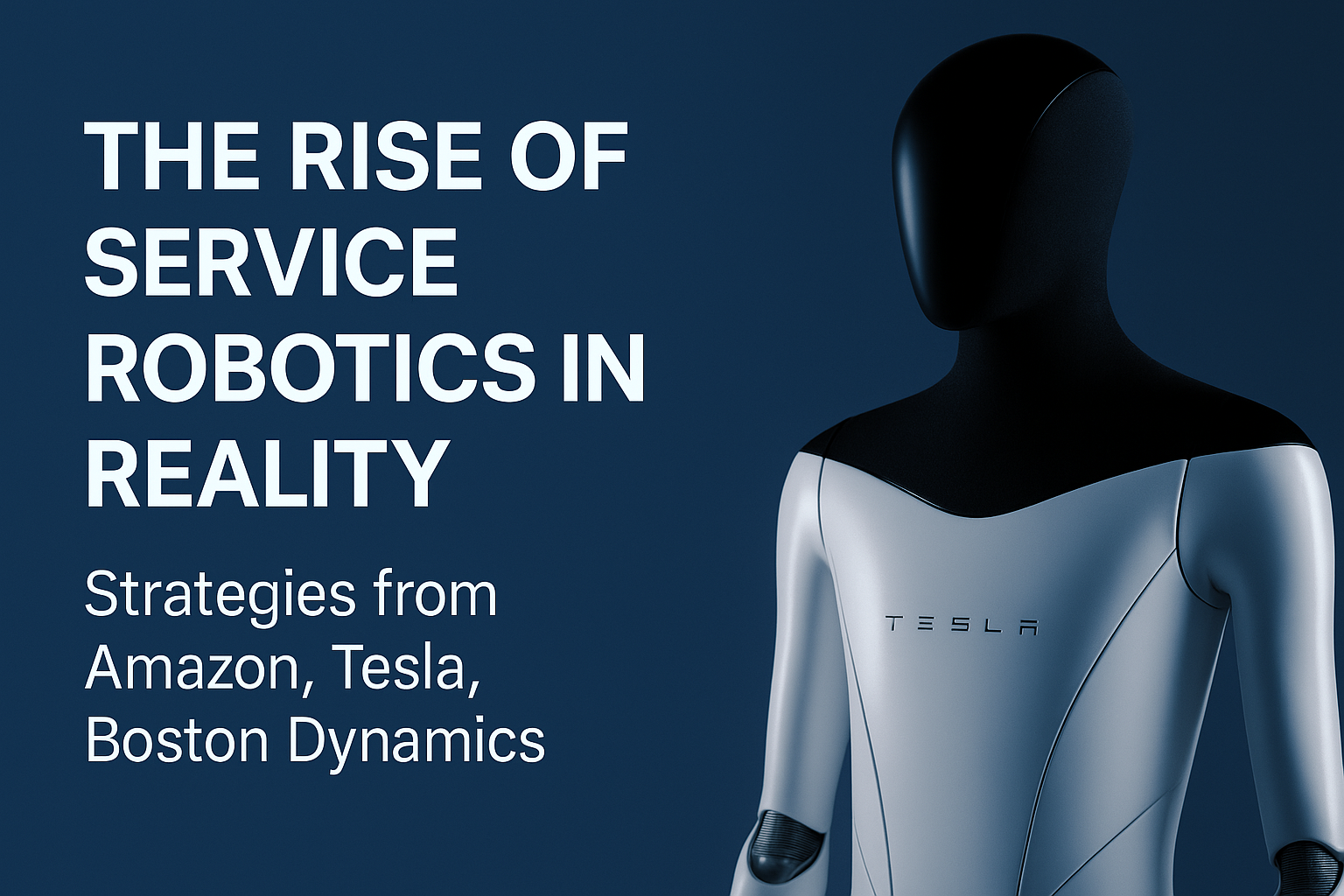

Service robots – machines that perform useful tasks for humans beyond traditional factory automation – are no longer just futuristic concepts. They are increasingly working alongside us in warehouses, on roads, and even in our homes. A surge in innovation and investment has led to a real rise of service robotics in recent years. Global sales of professional service robots jumped by about 30% in 2023, with logistics and delivery robots leading the growth. From e-commerce giants to automotive companies and dedicated robotics firms, industry leaders are betting big on robots to transform work and daily life.
Three companies exemplify this trend through distinct strategies: Amazon, Tesla, and Boston Dynamics. Each approaches service robotics from a different angle – integrating robots into fulfillment operations, developing humanoid helpers, or turning cutting-edge prototypes into products. Together, their efforts illuminate how service robots are becoming mainstream. Below, we delve into each of their strategies and what they mean for the future of robotics.
Amazon’s Warehouse Automation Strategy

Robotic arms sorting packages in an Amazon fulfillment center. Amazon’s warehouses deploy robots at massive scale to assist human workers.
Amazon has quietly built one of the world’s largest robotic workforces. Since acquiring Kiva Systems in 2012, Amazon transformed its fulfillment centers with automation. Today, over 750,000 robots operate in Amazon’s warehouses lifting shelves, sorting packages, and moving items with speed and precision. These robots range from squat autonomous vehicles that ferry inventory across the floor, to towering robotic arms that can individually pick products. Eight different robotic systems coordinate in Amazon’s newest facilities, all aimed at boosting productivity and safety for human employees on the floor.
The core of Amazon’s strategy is augmenting workers, not replacing them. Robots handle the heavy lifting and repetitive fetching, while people focus on tasks requiring judgment and dexterity. For example, mobile drive units (originally Kiva robots) nicknamed “Hercules” carry tall inventory pods to employees, saving them miles of walking. Autonomous bots like “Proteus” can navigate around people to haul carts of goods. Meanwhile, advanced robotic arms such as “Sparrow” use computer vision and AI to sort individual products into orders. By letting robots bring items to ergonomic workstations and do the grunt work, Amazon reduces strain injuries and allows human pickers to be more efficient.
“We can have faster delivery times because of the work that we’ve done in robotics. We can also pass on a lower cost. And we’re creating thousands and thousands of jobs because of it,” says Tye Brady, Chief Technologist at Amazon Robotics, underscoring how automation and workforce growth go hand-in-hand.
Amazon backs up this philosophy with significant resources. The company has a 16,000-strong team dedicated to robotics and is continually investing in new automation technology. It launched the $1 billion Amazon Industrial Innovation Fund in 2022 to invest in robotics startups. Through this fund Amazon has supported firms like Agility Robotics, whose bipedal robot “Digit” is being tested to handle totes and boxes in Amazon facilities. By investing in external innovation and in-house R&D, Amazon ensures it stays at the cutting edge – whether it’s applying advanced AI for robotic vision or deploying new types of warehouse robots. Analysts estimate these initiatives will pay off in efficiency; Amazon’s automation could save the company $10 billion annually by 2030 through faster operations and lower costs.
Importantly, Amazon’s service robot ambitions aren’t confined to the warehouse. The company has experimented with last-mile delivery robots (like the sidewalk-traveling Scout) and even home robots (such as the Alexa-integrated Astro) for security and assistance. While those consumer robots are still early-stage, they signal Amazon’s broader vision: a future where robots assist with tasks from factory floors to front doors. For now, Amazon’s primary impact is in logistics. By blanketing its fulfillment network with robots and integrating them seamlessly with human labor, Amazon showcases how service robots can achieve massive scale in a specific domain. The result is an automation empire that keeps packages flowing to customers at unprecedented speeds, setting a template for others to follow.
Tesla’s Humanoid Robot Ambitions

Tesla’s prototype humanoid robot, Optimus, performing a task in a Tesla factory environment. The company envisions these human-sized robots taking on physical jobs.
While Amazon focuses on specialized robots, Tesla is taking a bold leap toward general-purpose humanoid robots. In 2021, Tesla’s CEO Elon Musk unveiled “Optimus”, a bipedal robot project aiming to leverage Tesla’s expertise in artificial intelligence and manufacturing. The vision is ambitious: Tesla believes humanoid robots could handle a wide range of manual tasks and even outnumber Tesla’s car business in economic impact one day. Instead of automating one workflow, Tesla is designing a robot that could potentially do “whatever a human can do, but better” – from stocking shelves to assisting in homes – by literally having two legs, two arms, and a human-like form to navigate our world.
Tesla’s strategy with Optimus is an extension of its self-driving car development. The company is repurposing the AI software, sensors, and powerful Dojo supercomputer (used to train Autopilot vision models) to give the robot spatial awareness and decision-making capabilities. In effect, the Optimus robot uses a modified version of a Tesla car’s “brain” to perceive surroundings and perform actions. Early prototypes of Optimus have been shown carefully walking, picking up objects like small factory parts, and manipulating components on an assembly line. Much of this progress is enabled by Tesla’s neural network software that lets the robot interpret camera feeds and coordinate its limbs, similar to how a Tesla car navigates roads. The hardware draws on Tesla’s manufacturing know-how too – the robot’s actuators (electric motors at its joints) are being designed with mass production in mind, using techniques from making automotive components.
Despite being in prototype stage, Tesla is moving quickly toward deployment. Musk has set an aggressive roadmap: internally Tesla is aiming to build 10,000 Optimus units in 2025, ramping up to even larger volumes in subsequent years. “Will we succeed in building 10,000 exactly by the end of the year? Probably not,” Musk admitted about the target, “but will we make several thousand? Yes… Will those robots be doing useful things? I’m confident they will.” In the near term, Tesla plans to use these humanoids in its own factories. Imagine fleets of Optimus robots carrying materials, fastening bolts, or performing routine inspections in Tesla’s auto plants – effectively acting as extra pairs of hands for tedious jobs. This internal deployment not only helps Tesla improve its manufacturing efficiency, but also serves as a real-world testing ground to refine the robots before offering them to other customers.
Tesla’s endgame is to create a multipurpose robotic worker that can be sold broadly, potentially becoming a new consumer (or enterprise) product line. Musk has suggested that once they achieve economies of scale, the Optimus robot could cost under $20,000 per unit, making it affordable for many businesses and even some households. Starting as soon as 2026, Tesla intends to make Optimus available to third-party companies and developers, expanding its use beyond Tesla’s own facilities. The potential applications are vast – construction, caregiving, retail, you name it – but realizing this potential will depend on continued advances in AI and robotics engineering.
Tesla’s humanoid bet is not without challenges or skeptics. Building a reliable bipedal robot that can handle unpredictable real-world scenarios is enormously difficult. So far, most public demos of Optimus have been tightly controlled, and observers note that some actions appear pre-programmed or teleoperated by humans. It will take time for Tesla to prove that Optimus can work autonomously with the level of safety and adaptability required for widespread use. Nevertheless, the company’s entry into service robotics is significant. By committing its brand and resources to humanoid robots, Tesla has reframed the conversation from if humanoid helpers will become reality to when. Its strategy highlights an all-in approach: bet big on AI, iterate fast on prototypes, and scale up manufacturing to push robots into everyday life. If Tesla succeeds, Optimus could usher in a new era where hiring a robot for physical tasks is as common as buying a car – fundamentally reshaping labor and productivity in the process.
Boston Dynamics: Commercializing Cutting-Edge Robotics

Boston Dynamics’ all-electric Atlas humanoid robot, shown here with its new design featuring a circular sensor head. The company is moving from viral demos to real-world pilots in factories.
No discussion of service robotics is complete without Boston Dynamics, the company famed for robots that can dance, backflip, and move with uncanny agility. For decades, Boston Dynamics operated more like a research lab than a commercial enterprise – producing one-off robotic marvels funded by military grants or parent companies. Its videos of the dog-like Spot trotting through offices or the humanoid Atlas doing parkour have captivated millions online. Now, under the ownership of Hyundai Motor Group, Boston Dynamics is laser-focused on turning its cutting-edge prototypes into practical service robots that businesses can actually use.
Boston Dynamics’ strategy centers on mastering complex mobility, then finding high-value tasks for those mobile robots. Take Spot, for example. In 2019, Spot became the company’s first robot offered for sale. This four-legged machine can climb stairs, traverse rough terrain, and carry sensors – capabilities that let it go where wheels or humans might struggle. Instead of mass consumer adoption, Boston Dynamics targeted industries like oil & gas, utilities, construction, and public safety. In those domains, Spot serves as an inspector and data-gatherer: it patrols sites with cameras and thermal sensors, checks for anomalies in industrial equipment, and keeps humans out of hazardous areas. Hundreds of Spot units have been deployed worldwide, used by companies and agencies to automate routine inspections of factories, power plants, and even bomb squads. By solving the problem of mobility in unpredictable environments, Spot has carved out a niche as an agile surveillance and inspection tool – a clear example of service robotics adding value in the field.
Building on Spot’s commercial traction, Boston Dynamics next set its sights on logistics automation (much like Amazon’s realm). It developed Stretch, a warehouse robot equipped with a large extendable arm designed to move boxes. Stretch can roll into a truck trailer, pick up packages stacked on the floor with its suction gripper, and place them onto conveyors – automating one of the most physically demanding warehouse jobs (truck unloading). The robot leverages Boston Dynamics’ expertise in balance and manipulation to work in tight, unstructured spaces like trailers. Early trials of Stretch are underway in distribution centers, indicating Boston Dynamics’ intent to compete in the booming warehouse automation market. Unlike Amazon’s in-house robotics or Tesla’s humanoid approach, Stretch is a more specialized service robot – purpose-built to tackle a specific manual labor task alongside human warehouse staff.
The company’s most iconic robot, Atlas, is a bipedal humanoid that for years served as an R&D project to push the limits of locomotion. Atlas famously wowed observers by leaping between platforms and doing gymnastic feats, but those versions were bulky, hydraulically powered, and not intended for sale. In 2024, Boston Dynamics unveiled a new, fully electric Atlas with a sleeker design and practical applications in mind. This next-generation Atlas trades some acrobatics for reliability – it’s still extremely agile, but engineered to be safer, stronger, and battery-powered for use in real workplaces. Boston Dynamics has made it clear that Atlas is moving toward commercialization. Pilot programs are planned: Atlas will be tested in Hyundai’s automotive factories, performing tasks like moving components or handling tools in coordination with human workers. A few other select partners will get early units as well. Essentially, Boston Dynamics aims to prove that a humanoid robot can add value in industrial settings, doing repetitive or ergonomically challenging jobs on the factory floor.
“In the months and years ahead, we’re excited to show what the world’s most dynamic humanoid robot can really do — in the lab, in the factory, and in our lives,” the company said, signaling its commitment to bring Atlas out of the lab and into everyday use.
Commercializing advanced robots is a challenging journey, and Boston Dynamics is proceeding cautiously. The company has stated that Atlas’ general release to the market will depend on success with these pilots and further improvements. In parallel, they continue to upgrade the robots’ software intelligence – integrating computer vision and machine learning so that Spot, Atlas, and Stretch can operate with increasing autonomy and safety. Notably, Boston Dynamics and its peers are also working with policymakers to shape the industry. The firm (along with others like Tesla) has even called for a national robotics strategy in the US, highlighting how strategic this field has become on a global scale. By combining Hyundai’s manufacturing prowess with its own robotics brilliance, Boston Dynamics is positioning itself to finally scale up production and deploy robots in larger numbers. If Spot was the company’s first commercial hit, Atlas and Stretch might be the next – potentially addressing labor shortages in factories, warehouses, and other service sectors.
Boston Dynamics’ approach exemplifies a robotics pure-play tackling real-world service tasks step by step. Rather than flooding workplaces with robots overnight, the company refines each machine’s capabilities through iteration and pilot partnerships. The end goal, however, aligns with the broader vision shared by Amazon and Tesla: robots becoming common helpers that improve productivity and safety across industries. Whether it’s a legged robot inspecting a remote pipeline, or a humanoid eventually helping a technician on an assembly line, Boston Dynamics is turning years of spectacular demos into practical solutions – and in doing so, propelling service robotics into a new era.
Comparison of Robotics Strategies: Amazon vs Tesla vs Boston Dynamics
| Aspect | Amazon | Tesla | Boston Dynamics |
|---|---|---|---|
| Main Focus | Logistics and warehouse automation | General-purpose humanoid robots | Agile mobile robots for inspection and logistics |
| Key Robots | Proteus, Sparrow, Sequoia | Optimus | Spot, Stretch, Atlas |
| Deployment Scale | Over 750,000 robots globally | Prototype stage (thousands targeted by 2025) | Hundreds deployed commercially |
| Robot Capabilities | Item sorting, inventory management, transport | Walking, grasping, object manipulation | Mobility over rough terrain, precision handling |
| Strategic Goal | Enhance operational efficiency and worker safety | Mass-market adoption of humanoid robots | Commercialize advanced mobility and manipulation technologies |
| Primary Industry | E-commerce logistics | Manufacturing, general labor | Industrial inspection, logistics, safety |
| Production Cost | Moderate (scaled mass production) | Initially high, targeting under $20,000/unit | High (premium niche market) |
| AI Integration | Strong (cloud-based AI for coordination) | Advanced neural-network autonomy | High (autonomous navigation and complex manipulation) |
| User Experience | Ergonomic collaboration with human workers | General-purpose assistant, user-friendly interaction planned | Specialized tools for professionals, easy integration into workflows |
The New Era of Service Robotics
The strategies of Amazon, Tesla, and Boston Dynamics all point to an inflection point for service robotics. After decades of anticipation, robots are now graduating from research labs into the real world in significant numbers. Crucially, these machines are not confined to sterile factory cages; they are moving through our warehouses, streets, and soon perhaps our homes and offices. Each of the three companies discussed is tackling the challenges from different angles – one through incremental integration of robots into its workforce, another by designing a disruptive humanoid from scratch, and the third by translating robotics research into marketable products. Their varied approaches underscore that “service robotics” is a broad frontier, with room for many types of robots and use cases.
A common thread is the rapid advancement of AI and sensors, which has made today’s service robots far more capable than those of even a few years ago. Modern robots can see and interpret their environment with computer vision, learn from large datasets or trial-and-error (via machine learning), and react in real time to changes. This intelligence is what allows Amazon’s robots to safely navigate busy warehouse corridors, or Tesla’s Optimus to potentially work among humans, or Boston Dynamics’ Spot to autonomously patrol a facility. As AI technology continues to evolve, we can expect service robots to become even more adept – handling more variability, making more independent decisions, and interacting more naturally with people.
The impact on businesses and society is poised to be significant. In industry, service robots are already alleviating labor shortages and taking on dirty or dangerous jobs. Warehousing and logistics – facing immense pressure from e-commerce demand – have embraced robots to boost throughput, a trend led by Amazon and increasingly followed by its competitors. Other sectors like healthcare, retail, hospitality, and security are experimenting with service robots for tasks such as cleaning, delivery, customer service, and surveillance. Analysts project the global service robotics market to grow from about $26 billion in 2025 to over $90 billion by 2032, reflecting the huge opportunity seen in these technologies. If humanoid robots like Tesla’s and Boston Dynamics’ reach their potential, we may even see robots in roles that previously seemed exclusive to human workers, raising productivity to new heights and also prompting societal discussions about the future of work.
Challenges remain on the road ahead. Robotics engineers still grapple with the complexities of replicating human dexterity, ensuring safety in human–robot collaboration, and reducing costs. There are also ethical and social considerations – how to retrain workers for new roles alongside robots, how to set boundaries for robots’ use (as Boston Dynamics has advocated by pledging not to weaponize its creations), and how to secure robots against cyber threats or misuse. Yet, the momentum behind service robotics is undeniable. With technology titans and specialized firms alike pouring billions into development, the coming years will likely bring service robots that are smarter, more affordable, and more ubiquitous.
In essence, we are witnessing the real rise of service robotics: robots moving from novelty to normalcy. The endeavors of Amazon, Tesla, and Boston Dynamics demonstrate that robots can successfully take on useful tasks at scale – from speeding up supply chains to perhaps one day helping with household chores. As these strategies play out and inspire others, the presence of service robots will steadily expand into more facets of everyday life. What was once science fiction is becoming an everyday practical reality, driven by a blend of innovation, bold vision, and pragmatic deployment. The age of robots serving alongside humans has dawned, and its growth shows no signs of slowing down.
References
- Sales of Service Robots up 30% Worldwide – Annual report by the International Federation of Robotics highlighting rapid growth in professional service robot sales in 2023.
https://ifr.org/ifr-press-releases/news/sales-of-service-robots-up-30-worldwide - Amazon has more than 750,000 robots working in its fulfillment centers. Here are some of the things they can do. – Business Insider article detailing Amazon’s warehouse robots, their capabilities, and the company’s robotics investments and goals.
https://www.businessinsider.com/how-amazon-uses-robots-sort-transport-packages-warehouses-2025-2 - Elon Musk says Tesla aims to build 10,000 Optimus robots this year – Electrek report on Tesla’s humanoid robot plans, quoting Musk’s production goals and vision for the Optimus project as of early 2025.
https://electrek.co/2025/01/31/elon-musk-says-tesla-aims-to-build-10000-optimus-robots-this-year/ - Boston Dynamics’ humanoid Atlas is dead, long live the new commercial Atlas – The Register article on Boston Dynamics retiring its old Atlas and introducing a new electric version geared towards real-world applications, including quotes from the company about its plans.
https://www.theregister.com/2024/04/17/boston_dynamics_atlas_is_dead - Boston Dynamics expands Spot robot product line – Fox Business news piece (2021) noting that Boston Dynamics had sold over 400 Spot robots and introducing new accessories, illustrating early commercial success of its service robots.
https://www.foxbusiness.com/lifestyle/spot-expanded-line
Tags
#Robotics, #ServiceRobots, #Automation, #Amazon, #Tesla, #BostonDynamics, #ArtificialIntelligence, #WarehouseAutomation, #HumanoidRobots, #Logistics, #TechnologyTrends, #Innovation, #Industry4_0, #FutureOfWork



Leave a Reply